Helping Northeast Ohio Truck Owners Understand Unusual Steering and Drivetrain Noises
At RNS Service, we’ve been helping drivers throughout Orrville, Smithville, Dalton, Marshallville, Doylestown, and Rittman keep their vehicles dependable since 1977. As a third-generation family-owned repair shop, we’ve worked on countless Ford F-150 trucks over the years, and one concern that consistently brings truck owners into the shop is a grinding noise when turning.
For many drivers, the sound appears suddenly. It may happen while turning into a parking lot, navigating a sharp corner, backing out of a driveway, or maneuvering at low speeds. Some describe it as a grinding noise, while others call it a rubbing, growling, or metal-on-metal sound. Regardless of how it is described, the concern is understandable because unusual noises often raise questions about safety, repair costs, and whether the truck should continue to be driven.
The good news is that a grinding noise when turning does not automatically mean a major failure has occurred. In many cases, the problem can be identified and corrected before significant damage develops. However, because several different systems can create similar symptoms, proper diagnosis is essential.
Why Your Ford F-150 Might Be Making a Grinding Noise When Turning
One of the most challenging aspects of diagnosing a grinding noise is that multiple components can create remarkably similar sounds. This is why experienced technicians focus on identifying when the noise occurs rather than making assumptions about the cause.
Many truck owners immediately suspect brakes or wheel bearings. While those components can certainly contribute to grinding noises, they are not always the culprit. Ford F-150 trucks are equipped with steering, suspension, drivetrain, and four-wheel-drive systems that must work together. When one component begins to wear or malfunction, unusual noises often follow.
The timing of the noise can provide valuable clues. A grinding sound that only occurs during left turns may point technicians in a different direction than a noise that appears during right turns. Likewise, a noise that occurs only when four-wheel drive is engaged often suggests a different issue than one present at all times.
In our experience, many customers arrive convinced they know the source of the problem. However, professional inspections frequently reveal a completely different cause. What sounds like a wheel bearing may actually be a four-wheel-drive engagement issue. What sounds like brake contact may be related to steering or suspension wear. This is one reason why accurate diagnosis is so important before replacing parts.
Another factor affecting F-150 trucks in Northeast Ohio is road conditions. Potholes, rough roads, winter salt exposure, and towing demands place significant stress on steering and suspension components. Over time, these conditions can accelerate wear and contribute to noises that become more noticeable during turning maneuvers.
Understanding Ford F-150 IWE System Problems
One of the most common Ford-specific causes of grinding noises during turns involves the Integrated Wheel End system, commonly known as the IWE system.
Many Ford F-150 models use a vacuum-operated system that helps engage and disengage four-wheel drive components. When functioning properly, the system allows smooth transitions while minimizing unnecessary wear on drivetrain components. However, when vacuum leaks develop or IWE components begin to fail, grinding noises often occur.
Truck owners frequently report hearing the noise at lower speeds or during turns. In some situations, the noise becomes more noticeable when accelerating through a corner. These symptoms can easily be mistaken for wheel bearing or brake issues.
One reason IWE concerns are commonly misdiagnosed is that the symptoms overlap with several other front-end problems. An inexperienced diagnosis may result in unnecessary parts replacement while the original issue remains unresolved.
Our technicians often begin by determining whether the noise changes when four-wheel drive is engaged or disengaged. This information helps narrow the list of possible causes and can quickly identify whether the IWE system requires further testing.
Pro Tip: If your grinding noise changes when switching between two-wheel drive and four-wheel drive, avoid assuming the problem is a wheel bearing. The change in operating conditions can provide important diagnostic clues that help identify drivetrain-related concerns.
Ford trucks used for towing, hauling, or frequent stop-and-go driving may experience additional wear on related components. While not every grinding noise is linked to the IWE system, it remains one of the most common Ford-specific issues we encounter when diagnosing turning-related noises.
When a Grinding Noise May Signal a More Serious Problem
Although some grinding noises can be relatively minor, others may indicate a condition that should not be ignored.
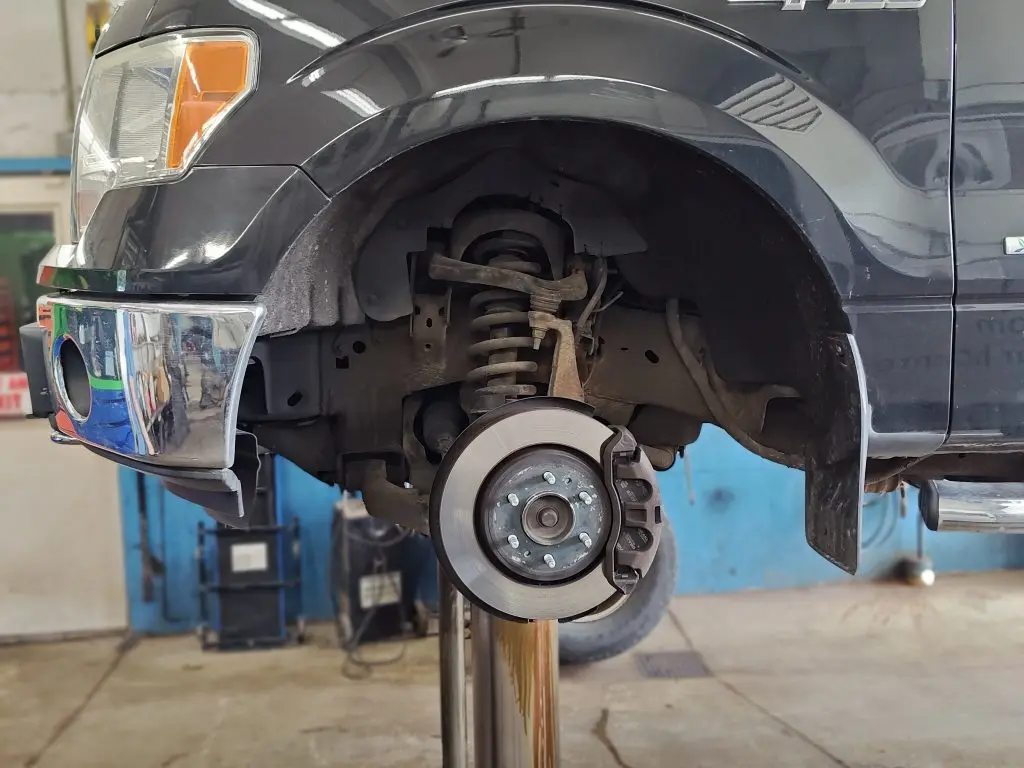
Wheel bearing failures are one example. A worn wheel bearing may initially produce a subtle growling sound that becomes louder over time. As wear progresses, the noise may become more pronounced during turns because additional load is placed on the affected bearing.
Brake-related concerns can also create grinding noises. Damaged hardware, worn components, or interference between braking components can produce sounds that become noticeable when steering input is added. In situations involving brake-related symptoms, a professional Ford truck repair inspection can help identify whether the issue extends beyond normal wear.
Steering and suspension components should also be considered. Ball joints, tie rods, and other front-end components are subjected to significant stress throughout the life of the vehicle. As these parts wear, unusual noises may develop during turning movements.
Drivetrain concerns deserve attention as well. If a grinding noise is accompanied by vibration, binding, difficulty steering, or unusual four-wheel-drive behavior, prompt inspection is recommended. Continuing to drive with an unresolved drivetrain issue can sometimes result in additional component damage.
Pro Tip: A grinding noise that is getting progressively louder should never be ignored. Even if the truck appears to drive normally, increasing noise often indicates worsening wear that can become more expensive if left unaddressed.
The key takeaway is that not every grinding noise represents an emergency, but every grinding noise deserves investigation. Identifying the source early provides the best opportunity to prevent additional repairs.
How Professional Diagnostics Identify the Real Cause
One of the biggest misconceptions among vehicle owners is that noises can be diagnosed accurately based on sound alone. While experienced technicians often recognize common patterns, proper testing is required before conclusions are reached.
At RNS Service, our diagnostic process begins with gathering information about the symptoms. Understanding when the noise occurs, how often it appears, whether four-wheel drive is involved, and whether the sound changes under different conditions helps narrow potential causes.
Road testing is often a critical part of the process. Replicating the customer’s concern allows technicians to observe the symptoms firsthand and identify patterns that may not be obvious during a stationary inspection.
From there, components are inspected systematically. Depending on the symptoms, technicians may evaluate wheel bearings, suspension components, steering systems, brake assemblies, drivetrain components, and vacuum-operated systems. Advanced Ford truck diagnostics help eliminate guesswork and ensure repairs address the actual cause rather than the symptoms.
Many truck owners are surprised to learn how often assumptions lead to unnecessary repairs. Replacing parts without proper testing can waste both time and money. This is why ASE-Certified Technicians follow structured diagnostic procedures designed to identify root causes accurately.
Organizations such as the National Institute for Automotive Service Excellence (ASE) establish standards that help ensure technicians maintain the skills necessary to diagnose increasingly complex vehicle systems.
Pro Tip: If multiple repair possibilities exist, always prioritize diagnosis before purchasing parts. A professional inspection often reveals a simpler solution than expected.
As a NAPA AutoCare Center and AAA Approved Auto Repair Facility, RNS Service emphasizes accurate diagnosis because solving the right problem the first time ultimately benefits both the customer and the vehicle.
Frequently Asked Questions
Can I continue driving my Ford F-150 if it makes a grinding noise when turning?
It depends on the cause. Some issues may allow limited driving, while others can affect steering, braking, or drivetrain performance. Because the source cannot be confirmed without inspection, professional diagnosis is recommended as soon as possible.
Is a grinding noise always caused by a bad wheel bearing?
No. While wheel bearings are a common cause, grinding noises can also result from IWE system concerns, brake hardware issues, suspension wear, drivetrain problems, and other front-end components.
Why does my F-150 only make the noise when turning?
Turning places additional load on certain steering, suspension, and drivetrain components. This added stress can make worn or damaged parts more noticeable, helping technicians narrow down the source of the problem.
Schedule an Inspection Before the Problem Gets Worse
If your Ford F-150 is making a grinding noise when turning, waiting for the problem to disappear on its own is rarely the best solution. While some issues may begin as minor concerns, continued operation can increase wear and potentially affect additional components.
For truck owners throughout Orrville, Smithville, Dalton, Marshallville, Doylestown, and Rittman, the experienced team at RNS Service provides accurate diagnostics and professional repairs backed by decades of experience. Our ASE-Certified Technicians understand the unique systems found in Ford trucks and use proven diagnostic procedures to identify the true source of unusual noises.
Whether the issue involves the IWE system, wheel bearings, brakes, steering components, or another drivetrain concern, early diagnosis can help prevent larger repairs and restore your confidence behind the wheel.
If you’ve noticed a grinding, growling, or rubbing noise while turning, schedule an inspection with RNS Service today or call us directly at (330) 683-6421. We’ll help determine the cause, explain your options clearly, and get your Ford F-150 back on the road safely.
Owen Stoller is a third-generation member of the Stoller family and serves as a Service Advisor at RNS Service in Orrville, Ohio. Carrying on a family tradition that began in 1977, Owen is committed to helping customers make informed decisions about their vehicles through honest communication, technical expertise, and a genuine commitment to their safety.
With five years of professional automotive experience, Owen has earned Master ASE Certification, including the prestigious ASE C1 Service Consultant certification. His combination of technical knowledge and customer service expertise allows him to bridge the gap between the repair shop and the vehicle owner, ensuring every customer understands their vehicle's needs and can make confident maintenance and repair decisions.
Owen earned his bachelor's degree in Supply Chain Management from The University of Akron, bringing a strong foundation in operations, organization, and problem-solving to the family business. He is passionate about continuous learning and regularly studies leadership to better serve both the RNS Service team and the customers who rely on them.
As the grandson of RNS Service founder Bob Stoller and the son of Jeff Stoller, Owen is proud to continue the values that have defined the business for nearly 50 years: integrity, quality workmanship, and treating every customer like family. He believes that auto repair is about more than fixing vehicles—it's about building lasting relationships based on trust and helping keep families safe on the road.
Outside the shop, Owen has been married to his wife, Carissa, for five years, and together they are raising their three children, Tucker, Wesley, and their youngest. Family life keeps him busy, whether he's hobby farming, making maple syrup, dreaming up new projects and ideas, or simply spending time with his children. Those same values of hard work, stewardship, and community continue to shape the way he serves customers every day at RNS Service.