Trusted Honda Diagnostics Backed by Decades of Experience
At RNS Service, we’ve spent decades helping drivers throughout Orrville, Smithville, Dalton, Marshallville, Doylestown, and Rittman understand what their vehicles are trying to tell them. As a third-generation family-owned repair shop serving the community since 1977, we’ve seen automotive technology evolve dramatically, especially in Honda vehicles. Modern Honda Civics and Accords are equipped with sophisticated safety, braking, steering, and engine management systems that constantly communicate with one another. While these systems improve safety and performance, they can also create confusion when multiple dashboard warning lights appear at the same time.
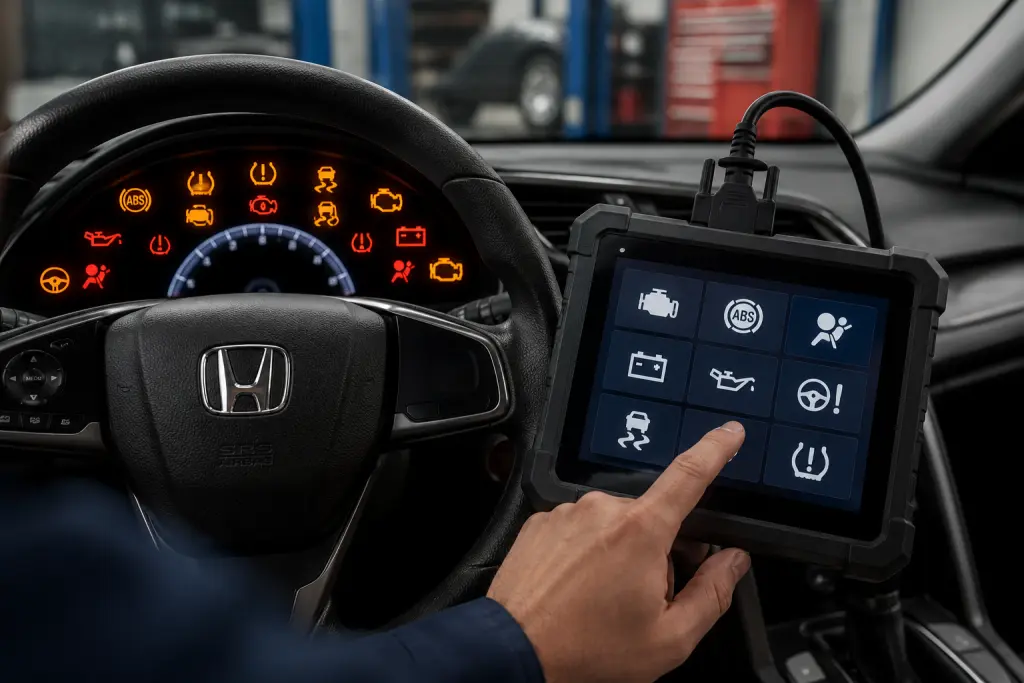
One of the most common concerns we hear from Honda owners is, “Why did all my warning lights suddenly come on?” It’s understandable to feel concerned when your dashboard lights up unexpectedly, especially when systems such as ABS, traction control, collision mitigation, lane departure warning, and the check engine light all appear at once. Fortunately, multiple warning lights do not always mean multiple failures. In many cases, a single underlying issue can trigger several alerts throughout the vehicle.
Understanding why this happens can help you make informed decisions, avoid unnecessary repairs, and know when professional diagnostics are needed.
Why Honda Vehicles Trigger Multiple Dashboard Warnings
Honda vehicles rely on a network of electronic control modules that share information throughout the vehicle. These systems are designed to work together. The engine control module, brake control module, power steering system, stability control system, and Honda Sensing technologies constantly exchange information to ensure the vehicle operates safely and efficiently.
When one system detects a fault, it can affect several other systems. As a result, the vehicle may disable certain safety features and illuminate multiple warning lights to alert the driver. This often surprises Honda owners because they assume every warning light represents a separate problem.
For example, a failed wheel speed sensor may trigger ABS warnings, traction control alerts, stability control messages, and additional dashboard notifications. Likewise, a charging system issue may create electrical irregularities that affect multiple modules simultaneously.
A phrase we frequently hear from customers is that their dashboard “lit up like a Christmas tree.” In many cases, our technicians discover that the root cause is far less dramatic than the number of warning lights suggests. The key is identifying the original fault before replacing parts unnecessarily.
The Most Common Causes We Diagnose at RNS Service
One of the most common causes of multiple warning lights on Honda Civics and Accords is a weak or failing battery. Modern Hondas are highly dependent on stable voltage. When battery performance begins to decline, electronic systems may struggle to communicate properly. This can result in seemingly unrelated warning lights appearing simultaneously.
Ohio winters can be especially hard on vehicle batteries. Temperature swings, cold starts, and increased electrical demands can accelerate battery wear. Many drivers are surprised to learn that a battery nearing the end of its life can create warning lights without causing immediate starting problems.
Another issue we frequently diagnose involves charging system failures. A failing alternator may not provide consistent voltage throughout the vehicle. When voltage fluctuates, control modules may generate fault codes and disable certain features as a protective measure. In situations like these, professional diagnostic services are critical because replacing the battery alone often fails to address the underlying problem.
Wheel speed sensor failures are another common culprit. These sensors play an important role in anti-lock braking systems, traction control, and stability control systems. When a sensor fails or becomes contaminated, the vehicle loses important data regarding wheel movement. As a result, multiple safety systems may become disabled until repairs are completed.
Brake system concerns can also contribute to dashboard warning lights. If warning indicators related to ABS or braking performance appear, it’s important to have the system inspected promptly. Our technicians often find that a seemingly minor issue can impact several interconnected safety systems. Drivers experiencing brake-related warnings should consider scheduling an inspection through our brake repair services to ensure the vehicle remains safe to operate.
Electrical connection issues are another common source of frustration. Corroded terminals, damaged wiring, loose ground connections, and moisture intrusion can all create intermittent faults that are difficult to identify without proper testing equipment. This is where experience matters. ASE-Certified Technicians understand how to isolate the source of electrical problems rather than relying solely on fault codes.
Warning Lights Honda Drivers Should Never Ignore
Although some warning lights may result from minor issues, others require immediate attention. One of the most important indicators is the brake warning light. If this light remains illuminated while driving, it could indicate a problem affecting braking performance or fluid levels. Because braking systems directly impact vehicle safety, these warnings should never be ignored.
The check engine light is another warning that deserves attention. While some engine faults may initially seem minor, delayed diagnosis can allow small issues to become expensive repairs. We’ve seen situations where a relatively simple ignition or sensor problem eventually led to catalytic converter damage because the vehicle continued to be driven without proper repairs.
Collision mitigation and driver assistance warnings should also be taken seriously. Modern Honda vehicles equipped with Honda Sensing technology rely on cameras, sensors, and communication networks to provide safety assistance. When these systems become disabled, important safety features may no longer function as intended.
Power steering warnings can also affect vehicle handling and driver confidence. If steering effort suddenly changes or warning messages appear, prompt diagnostics are recommended. Continuing to drive without understanding the cause can increase risks, particularly during emergency maneuvers.
As a general rule, warning lights accompanied by unusual noises, poor performance, hard starting, charging concerns, or braking issues should be inspected as soon as possible. The sooner a problem is diagnosed, the more likely it can be resolved before additional components are affected.
Why Accurate Diagnostics Save Honda Owners Money
One of the biggest misconceptions in the automotive industry is that a fault code automatically identifies a failed part. In reality, fault codes simply point technicians toward a system that requires further testing.
For example, a charging system code does not necessarily mean the alternator has failed. The root cause could involve wiring, battery condition, voltage regulation, or other electrical concerns. Replacing parts without proper testing often leads to unnecessary expenses and continued frustration.
At RNS Service, our ASE-Certified Technicians use professional diagnostic equipment and proven testing procedures to identify root causes rather than symptoms. This approach helps eliminate guesswork and reduces the likelihood of unnecessary repairs.
Honda vehicles are particularly dependent on accurate diagnostics because many systems are interconnected. A fault originating in one area may create symptoms elsewhere in the vehicle. Understanding how those systems interact requires both specialized tools and practical experience.
Organizations such as the National Institute for Automotive Service Excellence (ASE) emphasize ongoing training and professional standards because modern vehicle diagnostics continue to become more complex each year. Staying current with technology allows technicians to diagnose issues accurately and efficiently.
For many drivers, investing in professional diagnostics ultimately saves money by preventing misdiagnosis, unnecessary parts replacement, and avoidable component failures.
Frequently Asked Questions
Can a bad battery cause multiple warning lights on a Honda Civic or Accord?
Yes. A weak battery is one of the most common causes of multiple warning lights. Low voltage can disrupt communication between electronic control modules and trigger warnings across several vehicle systems simultaneously.
Is it safe to drive when multiple dashboard warning lights are on?
It depends on the cause. Some issues may allow limited driving, while others can affect braking, steering, charging, or engine performance. If multiple warning lights appear unexpectedly, professional diagnostics are recommended to determine whether the vehicle remains safe to operate.
Will disconnecting the battery clear the warning lights permanently?
Disconnecting the battery may temporarily reset some warning lights, but it will not correct the underlying issue. If the original fault remains, the warning lights will typically return once the vehicle completes its monitoring cycles.
Get Professional Honda Diagnostics Before a Small Problem Becomes a Major Repair
When multiple warning lights appear on your Honda Civic or Accord, guessing can quickly become expensive. The good news is that many of these situations can be accurately diagnosed and resolved before they lead to larger repairs. Whether the issue involves a battery, charging system, wheel speed sensor, brake system concern, or electrical fault, identifying the root cause early is the best way to protect your vehicle and your budget.
For drivers throughout Orrville, Smithville, Dalton, Marshallville, Doylestown, and Rittman, the team at RNS Service combines decades of experience with advanced diagnostic equipment to help uncover the real cause of warning light concerns. As a NAPA AutoCare Center, AAA Approved Auto Repair Facility, and shop staffed by ASE-Certified Technicians, we’re committed to providing honest answers and accurate repairs.
If your Honda dashboard has suddenly lit up with warning lights, don’t wait for the problem to worsen. Contact RNS Service today to schedule a professional inspection or call us directly at (330) 683-6421. We’ll help you understand what’s happening, explain your options clearly, and get you back on the road with confidence.
Owen Stoller is a third-generation member of the Stoller family and serves as a Service Advisor at RNS Service in Orrville, Ohio. Carrying on a family tradition that began in 1977, Owen is committed to helping customers make informed decisions about their vehicles through honest communication, technical expertise, and a genuine commitment to their safety.
With five years of professional automotive experience, Owen has earned Master ASE Certification, including the prestigious ASE C1 Service Consultant certification. His combination of technical knowledge and customer service expertise allows him to bridge the gap between the repair shop and the vehicle owner, ensuring every customer understands their vehicle's needs and can make confident maintenance and repair decisions.
Owen earned his bachelor's degree in Supply Chain Management from The University of Akron, bringing a strong foundation in operations, organization, and problem-solving to the family business. He is passionate about continuous learning and regularly studies leadership to better serve both the RNS Service team and the customers who rely on them.
As the grandson of RNS Service founder Bob Stoller and the son of Jeff Stoller, Owen is proud to continue the values that have defined the business for nearly 50 years: integrity, quality workmanship, and treating every customer like family. He believes that auto repair is about more than fixing vehicles—it's about building lasting relationships based on trust and helping keep families safe on the road.
Outside the shop, Owen has been married to his wife, Carissa, for five years, and together they are raising their three children, Tucker, Wesley, and their youngest. Family life keeps him busy, whether he's hobby farming, making maple syrup, dreaming up new projects and ideas, or simply spending time with his children. Those same values of hard work, stewardship, and community continue to shape the way he serves customers every day at RNS Service.